The 2026 World Press Freedom Index: The Lowest Score in 25 Years
RSF’s 25th World Press Freedom Index reports the lowest average score since the Index began in 2002. This post looks at the shape of that decline across zones and years, maps the 2026 scores against RSF’s own severity bands, and previews two closer looks at the sharpest single-year drops in the series.
pressfreedom.data
analysis
journalism
RSF
Author
Peter Baumgartner
Published
August 29, 2026
Modified
August 30, 2026
Peter Baumgartner
The lowest score in 25 years
In April 2026, RSF published its 25th World Press Freedom Index, and led with a stark framing: the average score across all 180 ranked countries and territories has never been lower since the Index began in 2002. For the first time in the Index’s history, more than half the world’s countries and territories now fall into the “difficult” or “very serious” categories — up from 13.7% in 2002. The share of the world’s population living somewhere rated “good” for press freedom has collapsed from 20% in 2002 to less than 1% today.
I’ve spent the last few posts building and cleaning pressfreedom.data, an R package that consolidates RSF’s rankings from 2002 through 2026 into one standardized table (see Encoding Resilience, When Data Cleaning Becomes Decision-Making, and Automation versus Judgment Calls). This post is the first of three that use that data to look closely at what a “25-year low” actually looks like, both in the aggregate trend and in RSF’s own account of why it’s happening.
Thirteen years of slow decline, then two cliffs
library(tidyverse)library(pressfreedom.data)data(rwb_standardized)df<-rwb_standardized|>filter(year_n>=2013, year_n<=2026)|>select(year_n, zone, score)|>drop_na()zone_avg<-df|>group_by(year_n, zone)|>summarise(score =mean(score), .groups ="drop")world_avg<-df|>group_by(year_n)|>summarise(score =mean(score), .groups ="drop")|>mutate(zone ="World")plot_data<-bind_rows(zone_avg, world_avg)ggplot(plot_data, aes(x =year_n, y =score, color =zone, linewidth =zone))+geom_line()+scale_linewidth_manual( values =c("World"=1.2, setNames(rep(0.6, n_distinct(df$zone)), unique(df$zone))), guide ="none")+scale_color_manual( values =c("World"="#000000","Africa"="#E69F00","Americas"="#56B4E9","Asia-Pacific"="#009E73","EU & Balkans"="#F0E442","Middle East & North Africa"="#D55E00","Eastern Europe & Central Asia"="#CC79A7"))+labs( title ="Press Freedom Score by Zone (2013-2026)", x ="Year", y ="Score", color ="Zone")+theme_minimal()+theme(legend.position ="bottom", legend.box ="vertical")
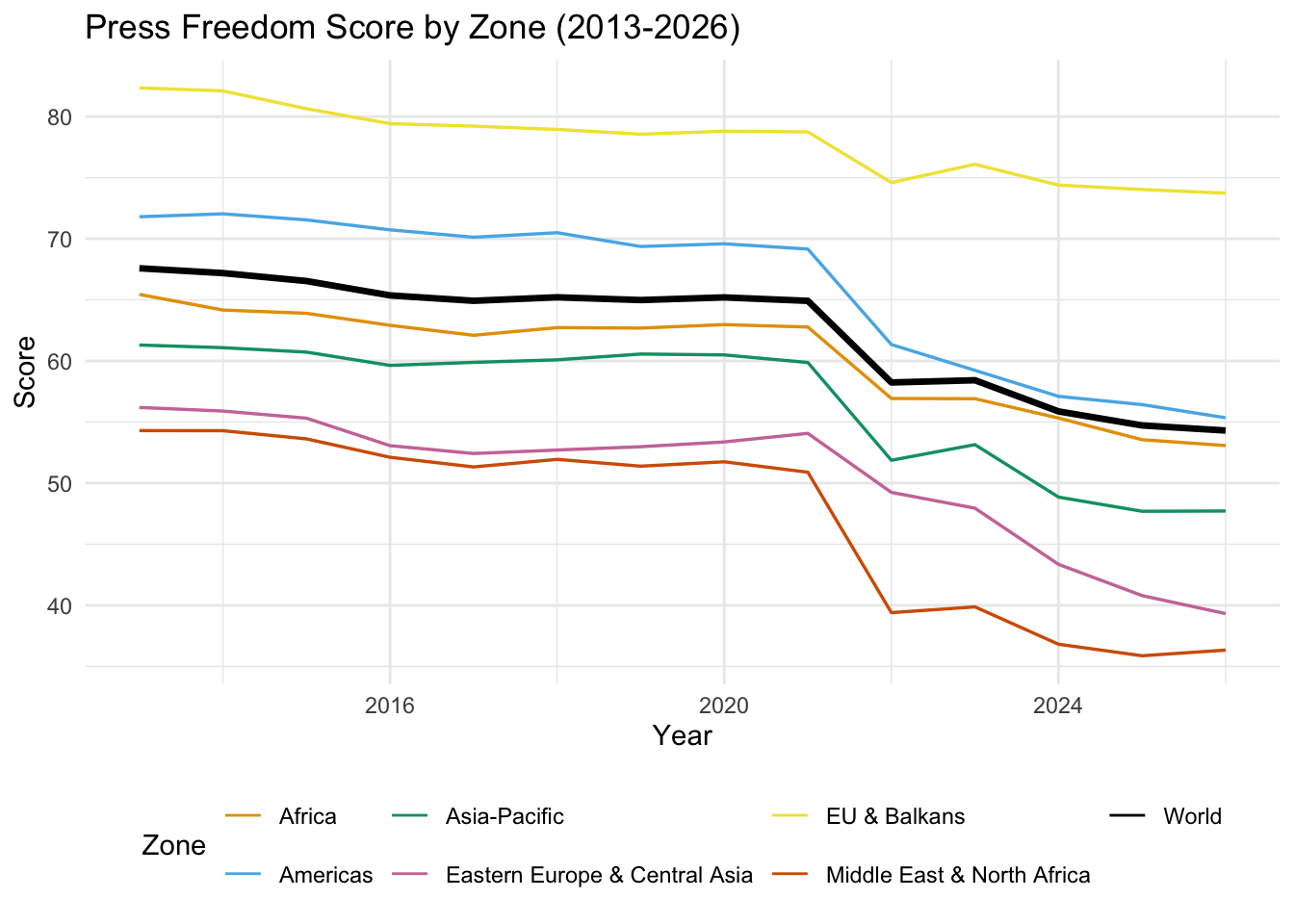
Figure 1: Press freedom scores by zone, 2013–2026. The black line is the world average. Two step-downs — 2021→2022 and 2023→2024 — interrupt an otherwise gradual, decade-long slide.
Every zone declines across this window, and no zone is spared even in the years where the world average holds roughly flat. But the shape isn’t a smooth slide — from 2013 to 2021 the world average drifts down by a point or so most years, and then two sharper step-downs interrupt that pattern: 2021→2022 and 2023→2024. Both are large enough, relative to the surrounding years, to be worth treating as distinct events rather than continuations of the underlying trend. The next two posts look at each one individually.
Where the world sits now
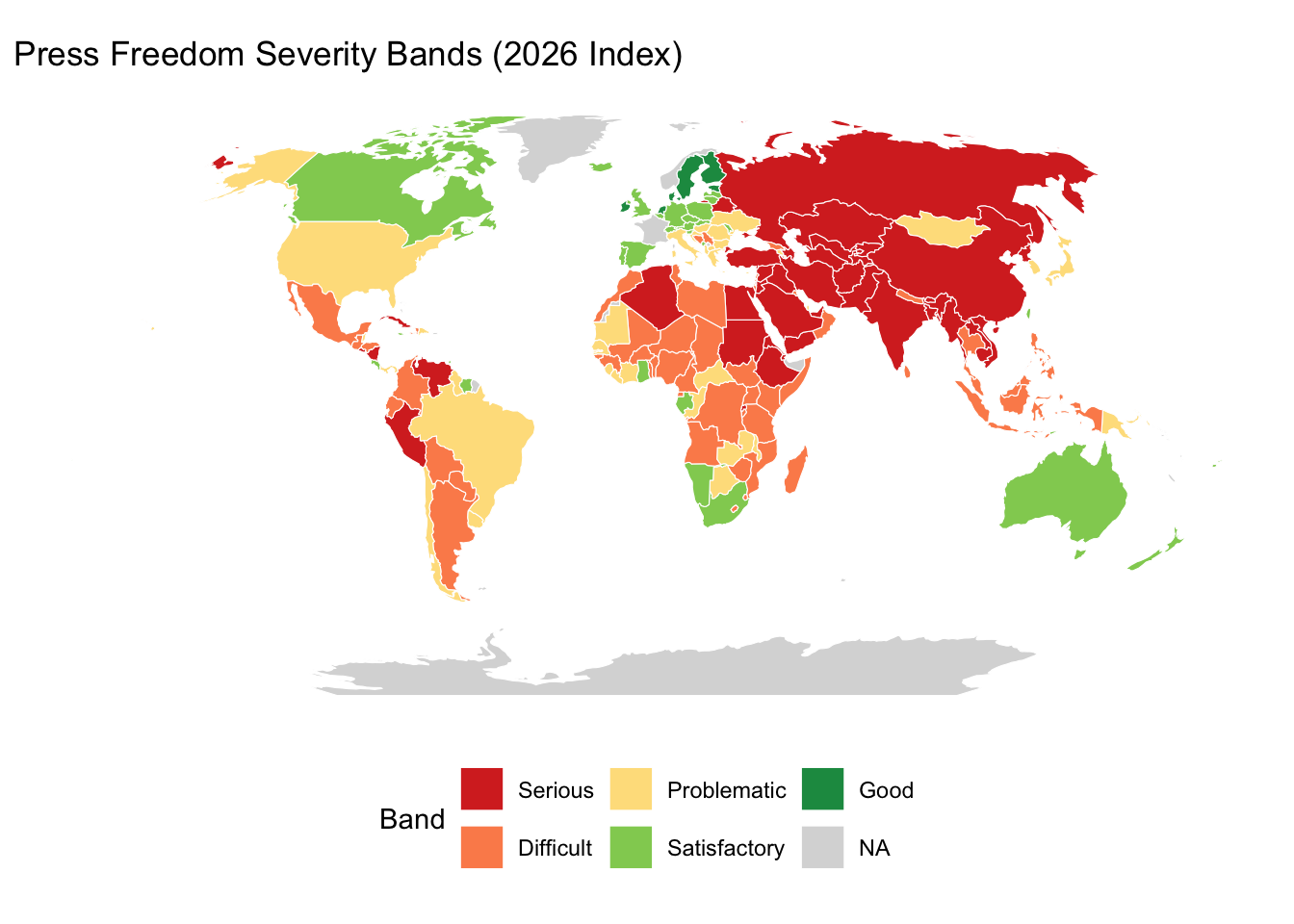
RSF sorts every country’s score into five bands: Good (85–100), Satisfactory (70–85), Problematic (55–70), Difficult (40–55), and Serious (0–40). Mapping the 2026 scores against those bands shows how much of the world now sits in the bottom two.
Figure 2: Press freedom severity bands by country, 2026 Index. Bands follow RSF’s own categories: Good (85-100), Satisfactory (70-85), Problematic (55-70), Difficult (40-55), Serious (0-40).
The map makes the “over half the world” statistic concrete: the red and orange bands stretch across most of Eastern Europe, Central Asia, the Middle East, and large parts of Africa and Asia, while the green bands are concentrated in a shrinking pocket of Northern and Western Europe plus a handful of outposts elsewhere (Canada, parts of Oceania, small pockets in Latin America and Africa).
RSF’s account: asphyxiation, not just repression
RSF’s own framing for 2026 is that the mechanisms of decline have diversified. The classic tools — imprisonment, violence, direct censorship — haven’t gone away, but they’re now joined by subtler, more legalistic and economic forms of pressure that reach even into established democracies.
Criminalization through law. RSF points to the legal indicator as the sharpest single mover this year, deteriorating in more than 60% of the 180 countries it tracks. Much of this runs through national security, defamation, and emergency legislation — laws originally justified for other purposes, now used to prosecute journalism as a side effect. RSF frames this as a 25-year legacy of the post-9/11 expansion of national security law, only now reaching a tipping point. Strategic lawsuits against public participation (SLAPPs) — costly legal actions designed to intimidate rather than win — are part of the same pattern, and RSF notes their spread from a handful of countries to a broader list including Bulgaria, Guatemala, and France.
Political hostility from elected leaders. Several of the year’s steepest national declines trace to heads of government treating the press as an adversary rather than a check. The United States dropped seven places, which RSF attributes to a “systematic policy” of attacks on journalists and press institutions by the U.S. president. Argentina under Javier Milei and El Salvador under Nayib Bukele both recorded significant drops tied specifically to deteriorating political and social indicators — not conflict or economic collapse, but governments treating criticism as something to be punished.
Economic pressure and platform dependence. RSF’s broader account of the past 25 years names predatory economic actors and under-regulated online platforms alongside authoritarian states as directly responsible for the decline — media outlets squeezed by shrinking advertising revenue and increasingly dependent on platforms whose incentives don’t align with independent journalism.
Armed conflict. Where wars are active, press freedom collapses fastest and most visibly. Since October 2023, more than 220 journalists have been killed in Gaza by the Israeli military, at least 70 of them while working. Sudan’s ongoing civil war has, in RSF’s words, all but wiped out independent journalism there. And the steepest single-country fall in the entire 2026 Index — Niger, down 37 places — reflects a broader collapse across the Sahel, where military juntas and armed groups have used security laws to shut out independent reporting.
None of these four mechanisms is new on its own. What’s distinctive about 2026, in RSF’s telling, is that they’re compounding at once, in democracies and autocracies alike, which is part of why the aggregate score keeps falling even in years without a single dominant crisis.
What’s next
The zone-trend chart above shows two step-downs sharp enough to separate from the general slide: 2021→2022 and 2023→2024. The next two posts look at each one on its own terms. The first — 2021→2022 — is the sharper of the two by world-average points, but RSF’s sub-indicator data for that year is missing, so the post relies on RSF’s contemporaneous reporting and geographic patterns rather than a clean decomposition. The second — 2023→2024 — has complete sub-indicator data, which makes a more direct kind of analysis possible: which of the five measured dimensions actually moved, and how that compares to what matters structurally across the whole series.
If you want to explore the data yourself, the companion Shiny app lets you drill into individual countries and zones, and the pressfreedom.data package has the full standardized table.